Commercial cleaning
For a broader facility plan with recurring tasks.
Learn about Commercial cleaningServing Rochester, Minnesota & surrounding areas
Mon–Fri 8am–6pm · Sat 9am–2pm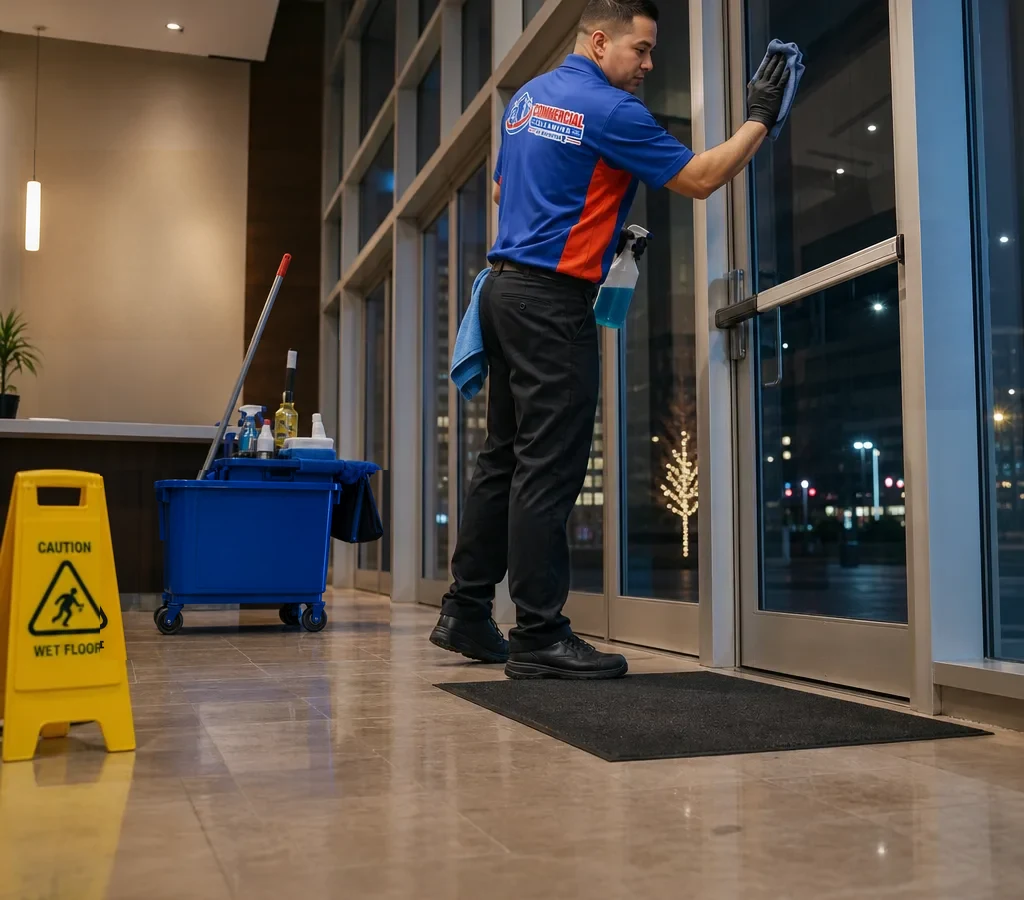
Restaurants · Rochester, Minnesota
A restaurant can look ready for service at a glance and still feel wrong the moment a guest settles in.
A tacky table edge, a dull patch on the glass by the door, a restroom handle with prints around it: small things, but guests register them before they have read the menu. Restaurant cleaning has one problem underneath most of the others: grease travels. It leaves the kitchen on shoes and in the air, and it lands on chair backs, floor edges, partition walls and entry glass, surfaces that look fine until somebody touches one.
A cleaning plan for restaurant spaces
The plan follows the route grime actually takes through the building rather than treating the dining room as a space to be reset after close. Layout, hours, guest volume and the surfaces taking the most contact all shape it.
A dining room floor can be swept and still carry a film that catches the light near the host stand. A booth can be wiped and still feel tacky at the edge where hands rest. Glass holds a haze that only shows when evening light hits it at an angle. Scope depends on the kitchen-to-dining route, the condition of the floors near entrances and service stations, and when the room is actually available to work in.
What goes wrong
Restaurants are hard on clean surfaces because the dirt does not stay where it lands. A floor can be swept and still carry a film that catches the light near the host stand. A booth can be wiped and still feel tacky at the edge where hands rest.
It gets worse when a room relies on fast repeated resets with no plan for buildup. Staff are focused on guests and the next table, which is the correct priority during service, but it means residue settles into the details guests inspect without meaning to: the base of a chair, the bottom of a door, the mirror, the strip of floor along the wall.
Cleaning also has to respect how the restaurant runs. A plan that ignores opening hours, floor drying time or the rush around meal periods adds friction rather than removing it. The point is a room that feels ready when guests arrive, without cleaning becoming one more thing to manage mid-service.
Local planning
A lot of the people eating in Rochester are somewhere unfamiliar: between appointments, after travelling in, or helping family through a hospital stay. They read a room quickly because they have no history with the place to balance out a poor first impression. Winter compounds it. Salt, slush and sand come in on boots and move from the mat through the waiting area into the dining room, and under steady traffic that material dulls a floor finish by the middle of the day.
Related services
For a broader facility plan with recurring tasks.
Learn about Commercial cleaningFor high-use hard floors, carpeted areas, and entry zones.
Learn about Floor careBefore you call
The places a busy shift skips: the edge of booth seats, undersides of tables, chair legs, partition walls, floor edges near service stations, and the lower part of entry doors. If the room looks acceptable from across the floor but feels sticky or hazy at close range, routine turnover is not reaching the buildup.
They collect more than tracked-in dirt. Grease moves out of the kitchen on shoes and settles into the routes between service areas, seating and the entrance. Sweeping lifts loose material; floor care is what addresses the film and the wear underneath it.
The entrance, glass, waiting area, the floor path to the table, and the restroom. All of it is seen before the food arrives, and none of it needs decorative treatment: it needs to be free of prints, tracked debris and residue.
Ready to discuss your facility?
Guests should notice the meal and the room, not a tacky surface or a smeared entry door. For restaurant cleaning in Rochester, call (507) 322-1140 or email [email protected].
Request a quote
Tell us about your restaurant, the areas that need attention, and your preferred schedule.