Janitorial service
For recurring building maintenance and checklists.
Learn about Janitorial serviceServing Rochester, Minnesota & surrounding areas
Mon–Fri 8am–6pm · Sat 9am–2pm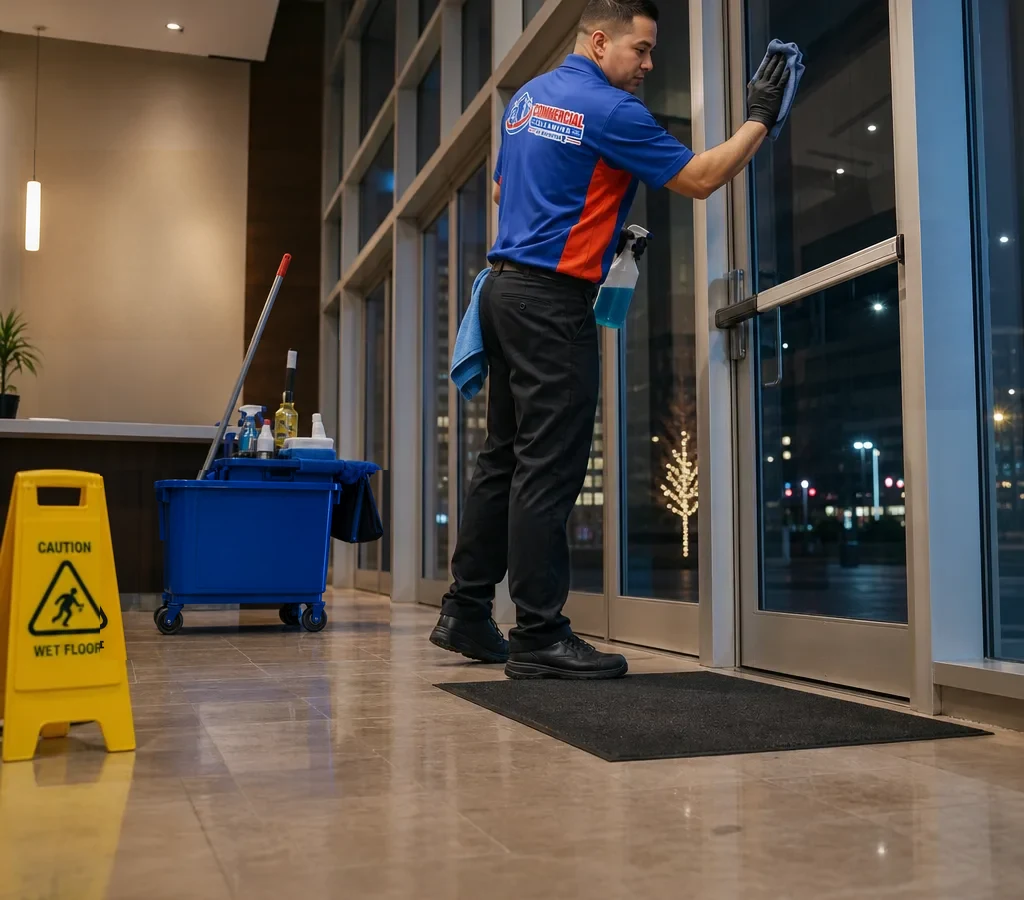
Commercial Cleaning · Rochester, Minnesota
The most expensive problem in commercial cleaning is not a bad clean.
It is a vague one. Nobody wrote down exactly who does what, so the gaps get absorbed quietly by the people who work in the building: the office manager who keeps paper towels in a desk drawer, the kitchen staff who mop at close because it was never clear whether the cleaners would. None of that shows up on an invoice, and none of it gets raised, because after a few months it stops feeling like a cleaning problem and starts feeling like how the building is.
A practical cleaning plan for Rochester facilities
A commercial cleaning plan is a list of decisions, not a list of rooms. What gets cleaned, how often, to what standard, and who is responsible when something falls between two definitions.
Scope depends on real things: how many entrances people actually use, what the floors are, how many restrooms carry the volume, how much of the building is public, and whether anything has been neglected long enough to need a reset before a routine can hold. Those answers come from walking the building, which is why we do that before quoting rather than after.
What goes wrong
When a scope is vague, the work does not go undone. It migrates, and it migrates to whoever notices first, which is almost always someone paid to do something else.
It shows up as a manager restocking the restroom because running out twice was worse than handling it themselves. As supplies kept in a desk drawer. As someone wiping the meeting room table before a client walks in. As a kitchen team mopping at close because nobody ever established whether that was theirs. None of it appears on an invoice and none of it gets escalated, because each individual task takes two minutes.
The cost is real anyway, and it compounds: the building is being cleaned twice, once by a contractor and once by staff, and only one of those is on the budget. A written scope is worth having mainly because it makes that invisible second shift visible.
Local planning
Rochester holds buildings to a high standard because so many of the people walking into them have travelled in for medical appointments and are reading an unfamiliar place for evidence that it is looked after. A medical office, the businesses serving patients and families, and any workplace with visitors all get judged in the first minute, on the entry glass, the floor by the door and the restroom. Winter is the other constant. Salt, slush and grit arrive for roughly five months, get ground into floor finish underfoot, and can make a well-run building look neglected by mid-morning. We treat the entry as its own job in that season rather than as the first ten feet of the lobby floor.
Related services
For recurring building maintenance and checklists.
Learn about Janitorial serviceFor hard floors, carpeted areas, and entry zones that need added attention.
Learn about Floor careBefore you call
Ask your own team what they have quietly started doing themselves. Restocking, wiping down a meeting room before a client arrives, a quick vacuum of the entry mat. Those tasks migrated because the scope never settled them, and they are the clearest evidence you have.
It replaces assumptions with a list. Pricing a commercial space from a phone call means guessing at floor type, entrance count, restroom volume and current condition, and the guess is either padded or too low to deliver. Walking it takes less time than most people expect.
Most commercial cleaning happens when the building is quiet, though some areas need daytime attention, particularly entries in winter. The schedule is built around when your space is actually usable rather than around a standard shift pattern.
Ready to discuss your facility?
If your own staff have quietly taken on jobs the cleaning was supposed to cover, that is the thing to tell us about. Call (507) 322-1140 or email [email protected].
Request a quote
Share the areas, timing, and priorities for your commercial cleaning needs.